 Museum of Jewish History

Inici Exhibitions Core exhibition Highlighted items
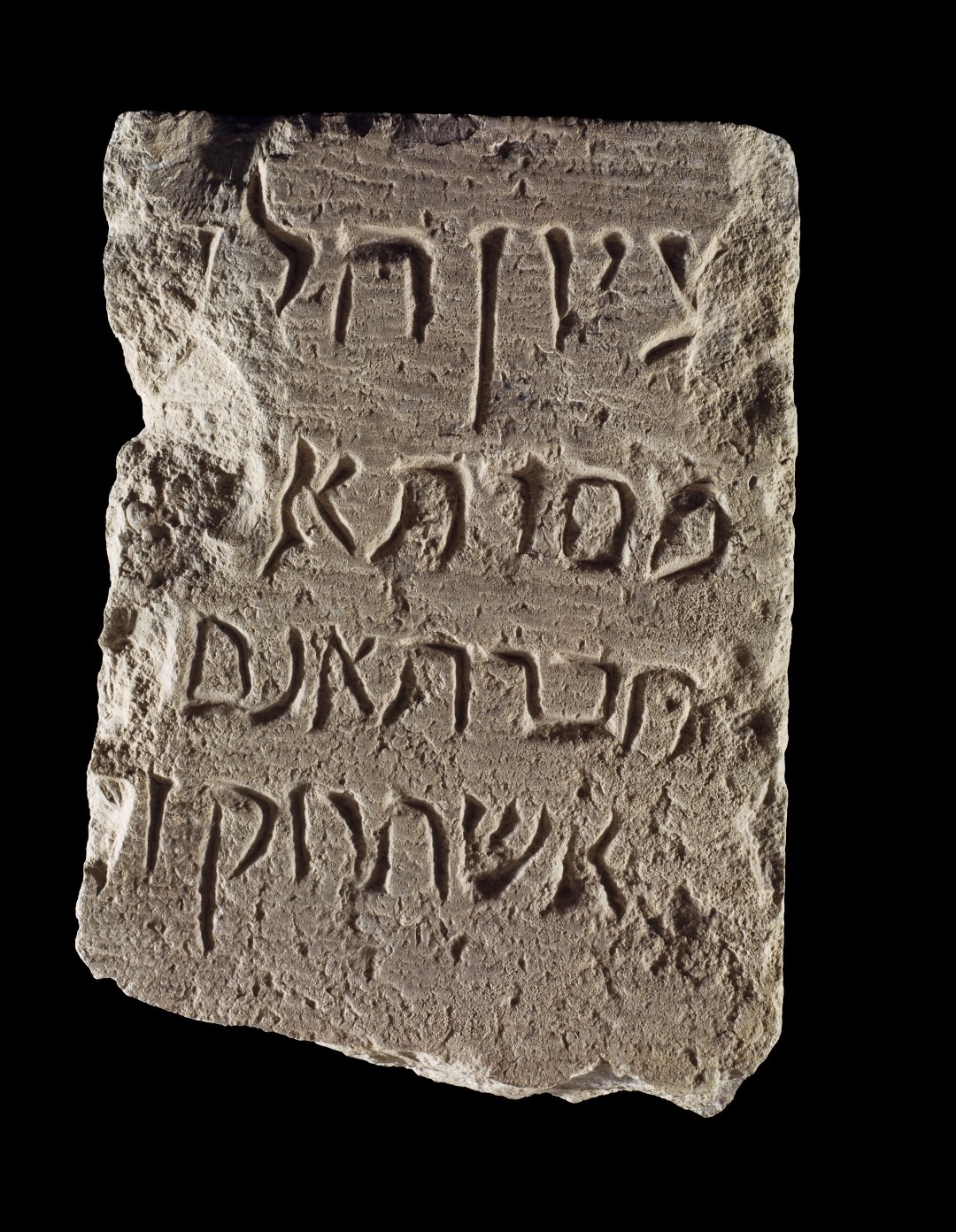
Stele of Astruga?, wife of Mossé Astruc
| Provenance | Girona |
| Chronology | First quarter of the 15th century |
| Material | Limestone |
| Registration | MHJ096 |
| Section | Cemetery |
Only the initial of the name has survived, which could be Astruga, as she was the wife of Mossé Astruc. Shortly before the riots of 1391, he appears as one of the new leaders of the aljama. After the attack, Mossé Astruc was among those confined in Torre Gironella, and he continued in Judaism. His name appears on the list of those who submitted book inventories in 1415, and we know how many volumes he owned at that time: thirty-two books (only five people owned a larger number of volumes). Mossé Astruc had a sister, Ester, who converted to Christianity under the name Joana and married Pere Joan, a convert (formerly Mossé Cabrit, son and heir of Abraham Cabrit, who was the brother of Salomó Cabrit). On 9 August 1395, Joana, Pere and Puigvert d'Agramunt sold an alodial house in the Jewish quarter to Mossé Astruc and his wife Dolça. In 1417, this couple sold a house in the Jewish quarter to Pere de Berguedà, provost of the Pia Almoina of the Cathedral. Documents from 1415 and 1416 also mention a courtyard that Mossé Astruc had sold to the aljama. This tombstone raises many questions, because the woman's name appearing on it does not match the name provided by archival documentation.
Translation:
(Side A)
This is the tombstone of [the grave]
of Lady A[struga?],
wife of En M[oses]
Astruc. Blessed be the memory of her.
(Side B)
This [is the gravestone of] Rabbi Cohen [...] aiar [...].


Patronat Call de Girona • C. de la Força, 8 - 17004 GIRONA • Tel. 972 216 761 • callgirona@ajgirona.cat