 Museum of Jewish History

Inici Exhibitions Core exhibition Highlighted items
Mikveh
| Archaeological area | Second floor |
| Section | Material heritage |
Ritual purification is essential in Judaism. It is carried out in the mikveh, where a full‑body immersion is performed three consecutive times in the ceremony known as "tevilah". According to legend, a Greek king who ruled ancient Israel prohibited the use of public ritual baths. Jewish women could no longer perform the tevilah at all the moments prescribed by Law in order to have sexual relations with their husbands in the proper manner. In this way, the tyrant sought to prevent the daughters of Israel from conceiving and multiplying their People. God, however, worked a miracle, and water springs appeared in every household to allow women to carry out ritual purification. This legend is recorded and illustrated in the Hamburg Miscellany (15th century).
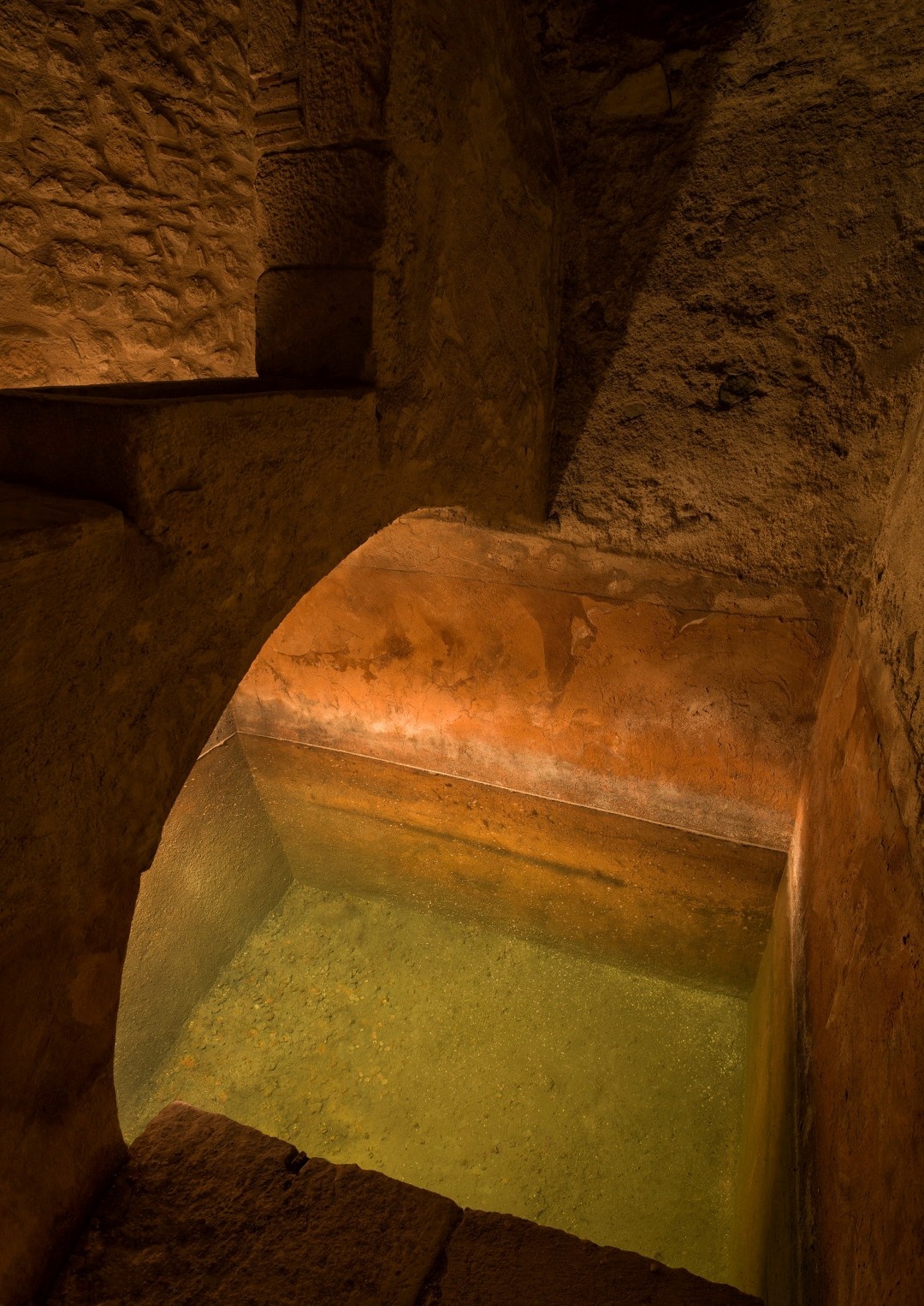
In the courtyard of the Museum of Jewish History, visitors can see the remains of the mikveh that operated from 1435 to 1492. It formed a closed complex accessed through a door. Inside, there was a small vestibule, a tiled changing room and the pool. One descended past the threshold connected to a stone‑slab landing, and from there probably to a submerged staircase, now lost. Water supply came through natural filtration but also through the cistern located in the courtyard (no. 7), which collected rainwater and channelled it into the bath.
The remains of the mikveh used by Girona's Jewish community between 1435 and 1492 are located on the second floor, across the courtyard. Its identification was made possible thanks to excavations carried out in February 2014 around the area of the old cistern. It is a small mikveh that collected rainwater, which reached it through a conduit uncovered during the excavations.


Patronat Call de Girona • C. de la Força, 8 - 17004 GIRONA • Tel. 972 216 761 • callgirona@ajgirona.cat