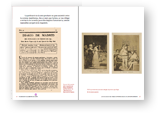
Far from his commissioned paintings, Goya in his engravings aesthetically explores and experiments with new themes and motifs. Here we find Goya the chronicler, a shrewd observer who goes so far as to flirt with poetry, as he often completes his images with epigrams or brief poetic compositions of moral, social or political content, with sharp, critical, satirical, sometimes burlesque and, at the same time, desperate prose. A Goya who demonstrates the highest level of mastery of the techniques and a sensitivity that moves forward on the path of modern art.
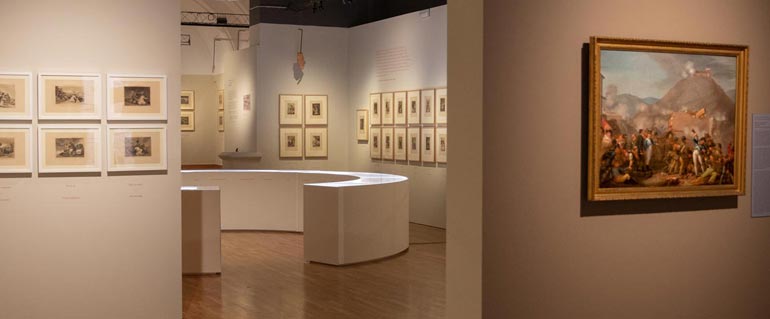
The Volaverunt exhibition Goya's engravings revisited by the contemporary eye is a unique opportunity to see in Girona the four great series of Goya's engravings, created between 1797 and 1819: Caprichos (Caprices), Desastres de la guerra (Disasters of war), Tauromaquia (Bullfighting) and Proverbios (Proverbs), also called Disparates (Nonsense).
The engravings, which come from the collection of the Mataró Museum, correspond to the printing executed in the workshops of the Calcografía Nacional in Madrid between 1937 and 1938. With this print run as the Spanish Civil War raged, the Republican government executed an operation of cultural prestige: this was the first time all four series had been printed jointly. The engravings are made using the technique of etching and aquatint (often burnished), in drypoint or burin. On a technical level, this edition - also called the "war series" and limited to 150 copies, of which the Mataró edition is no. 16- is one of the most valued for its printing and inking quality.
The set consists of 80 engravings from Caprices, 80 from Disasters of war, 40 from Bullfighting and 18 from Proverbs. The museum has held the engravings from each of the four series since 1944, when they were deposited there by the National Artistic Heritage Defence Service (SDPAN). All of them... except one. No one knows when or how it happened, but one engraving is missing, leaving the collection incomplete. The missing work is titled Se aprovechan (They avail themselves), and is engraving No. 16 from Disasters of war. The absence of this print was not documented until two decades later, which has given rise over time to all kinds of speculation about the reason for the disappearance. Was it an accident? Did someone deliberately take it? Who can say.
Volaverunt is one of the most iconic engravings from Caprices. The word volaverunt is Latin and means 'they flew away'. It indicates that something is missing, that something has disappeared. In this case: They avail themselves. This void is the starting point of Volaverunt. Goya's engravings revisited with a contemporary eye proposes a dialogue between Goya and contemporary art, through a series of works created specifically for this exhibition. It is a dialogue that questions the disappearance of the lost engraving, and takes flight from the four Goya series.
Irene Solà, Marcos Prior and Anna Dot help guide this dialogue. A set of approaches and drifts, which are shown again in this stop after their premiere in 2021 at Ca l'Arenas. Art Centre of the Museum of Mataró. Additionally, in the context of the exhibition it is presented for the first time the painting Defence of Girona on 19 September 1809, by Joan Carles Anglès (?-1822), an unpublished work acquired by the Generalitat de Catalunya and deposited at the Girona History Museum.
«The engraving series were for Goya a catharsis,
a purification, an escape from himself,
from the pains and anxieties that,
for personal or historical reasons,
took hold of his body or his soul
at decisive moments in his existence
»
Enrique Lafuente Ferrari. Los Desastres de la guerra de Goya y sus dibujos preparatorios, 1952


Ajuntament de Girona – Museu d'Història de Girona • Carrer de la Força, 27 - 17004 GIRONA • Tel. 972 222 229 • Terms of use